
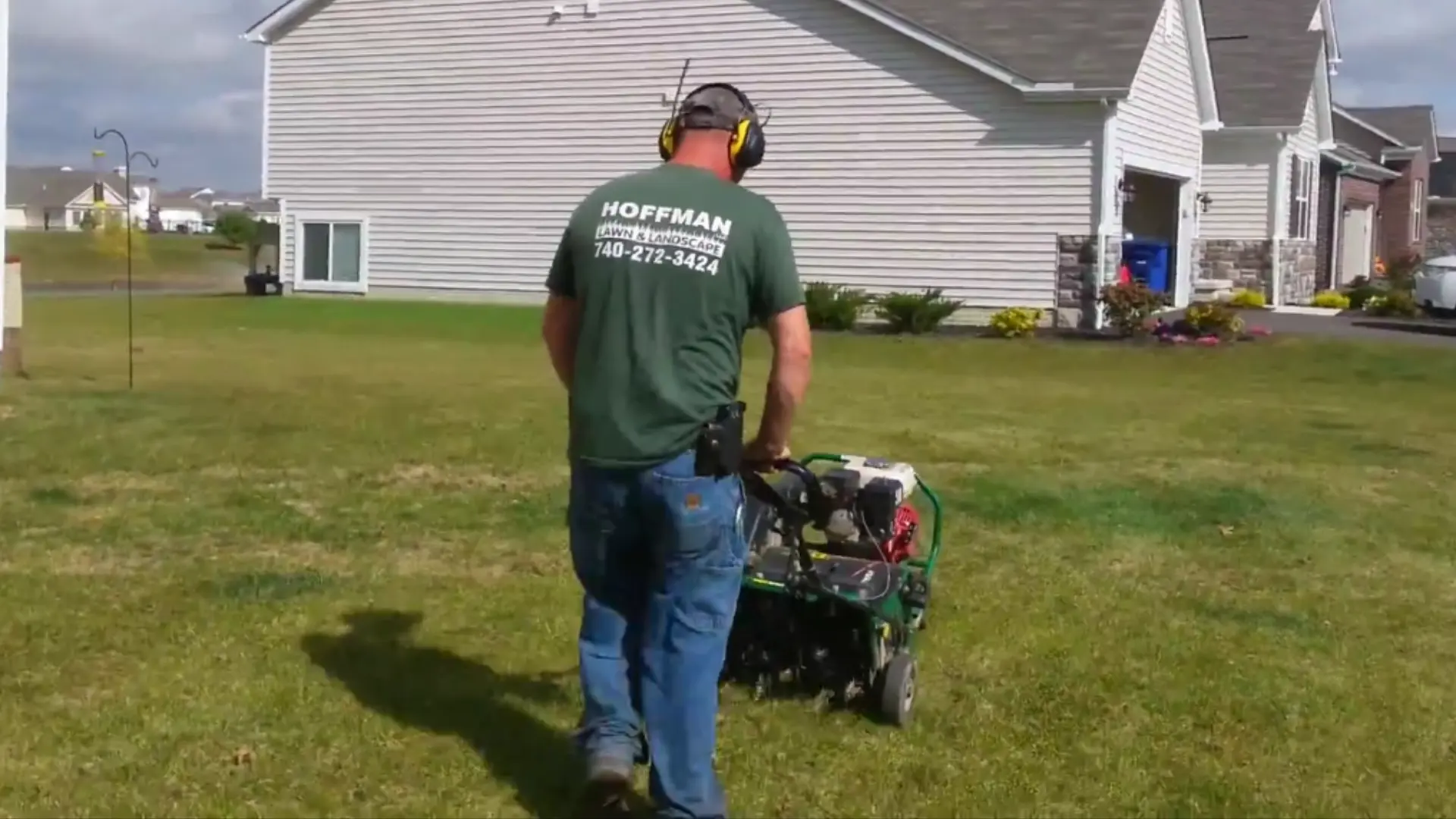
Thatch is a layer of organic matter between green vegetation and soil, consisting of dead and living shoots, stems, and roots. While some thatch protects the lawn, excess hinders water, nutrient, and air access, leading to shallow roots and increased pest susceptibility. Core aeration helps reduce thatch by removing soil plugs, exposing it to microorganisms that decompose the matter. This process also alleviates soil compaction and creates holes for better nutrient flow to roots. Regular aeration improves root health and promotes resilient grass growth, making it essential for maintaining a healthy lawn in Ohio.
What is thatch?
Thatch is a layer of organic matter that accumulates between the green vegetation and the soil surface. This layer consists of dead and living shoots, stems, and roots. While a minimal amount of thatch is normal and can protect your lawn from temperature extremes, excessive thatch—over half an inch thick—poses significant challenges. It can prevent water, nutrients, and air from reaching the soil and roots effectively, which can lead to shallow roots for your lawn, increased susceptibility to pests and diseases, and uneven turf. Understanding and managing thatch is crucial for maintaining a robust and resilient lawn.
Core aeration helps reduce thatch buildup on your lawn.
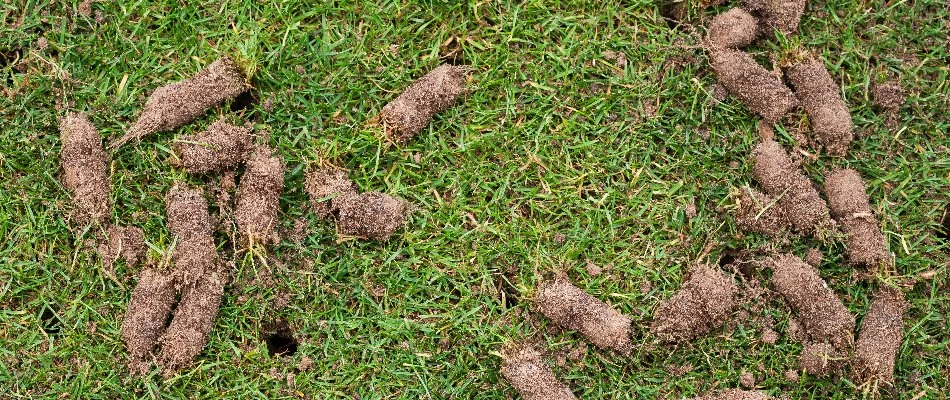
Core aeration can indeed help manage and reduce thatch. This process involves using a machine with hollow tines to remove plugs of soil from your lawn, effectively breaking up the thatch layer. By pulling up these plugs, core aeration exposes the thatch to microorganisms in the soil. These microorganisms play a key role in decomposing organic matter, which helps reduce the thatch naturally.
The act of aeration also ensures that the soil underneath gains greater access to air, water, and nutrients, which further encourages the breakdown of excess organic materials. For those battling thick thatch on their lawns, regular core aeration can be an effective strategy to aid in its reduction.
Other Benefits of Core Aeration
In addition to reducing thatch buildup, core aeration offers several other benefits for your lawn. One of the most significant benefits is that it alleviates soil compaction. Over time, the soil in your lawn can become compacted, making it difficult for air, water, and nutrients to reach the roots. By removing small plugs of soil, core aeration helps to loosen the soil and create space for these essential elements to penetrate deep into the root zone.
Another benefit of core aeration is that it creates holes in the ground that help nutrients and resources reach the roots of your grass more easily. When the soil is compacted, it can be difficult for these essential elements to reach the roots of your grass. However, by creating small holes in the soil, core aeration makes it easier for the roots to access and absorb the nutrients and resources that promote healthy grass growth.
Address thatch buildup with our core aeration service. Call us today to schedule!
Don't let thatch inhibit your lawn from getting the resources it needs to thrive. At Hoffmans Lawn & Fertilization, we offer a core aeration service that can help reduce thatch buildup on your lawn. Our core aeration process involves using an aerator machine to remove small plugs of soil from your lawn, which helps break up the thatch layer and allows it to decompose more easily. This service is offered in the fall from the beginning of September until mid-November.
We offer our core aeration service to homeowners and business owners, as well as HOAs, in Delaware, Lewis Center, Powell, and nearby areas in Ohio. With our core aeration service, you can enjoy a healthier, more vibrant lawn that can better withstand stress and disease. Call us today at (740) 318-5296 to schedule our core aeration service and take the first step towards a healthier lawn.


Comments (0)
Thanks for your comment!
Thanks for your feedback! Your comments have been successfully submitted! Please note, all comments require admin approval prior to display.
Error submitting comment!
There is a problem with your comment, please see below and try again.